Kahn's Theory Of Engagement

One can trace the roots of the concept back to the early history of team building, when researcher Elton
Mayo discovered that factors such as concern from upper management, more
pleasant physical conditions, and social ties with coworkers influenced a
worker’s mood and motivations, thus increasing both productivity and employee retention rates. (Robinson, 2022)
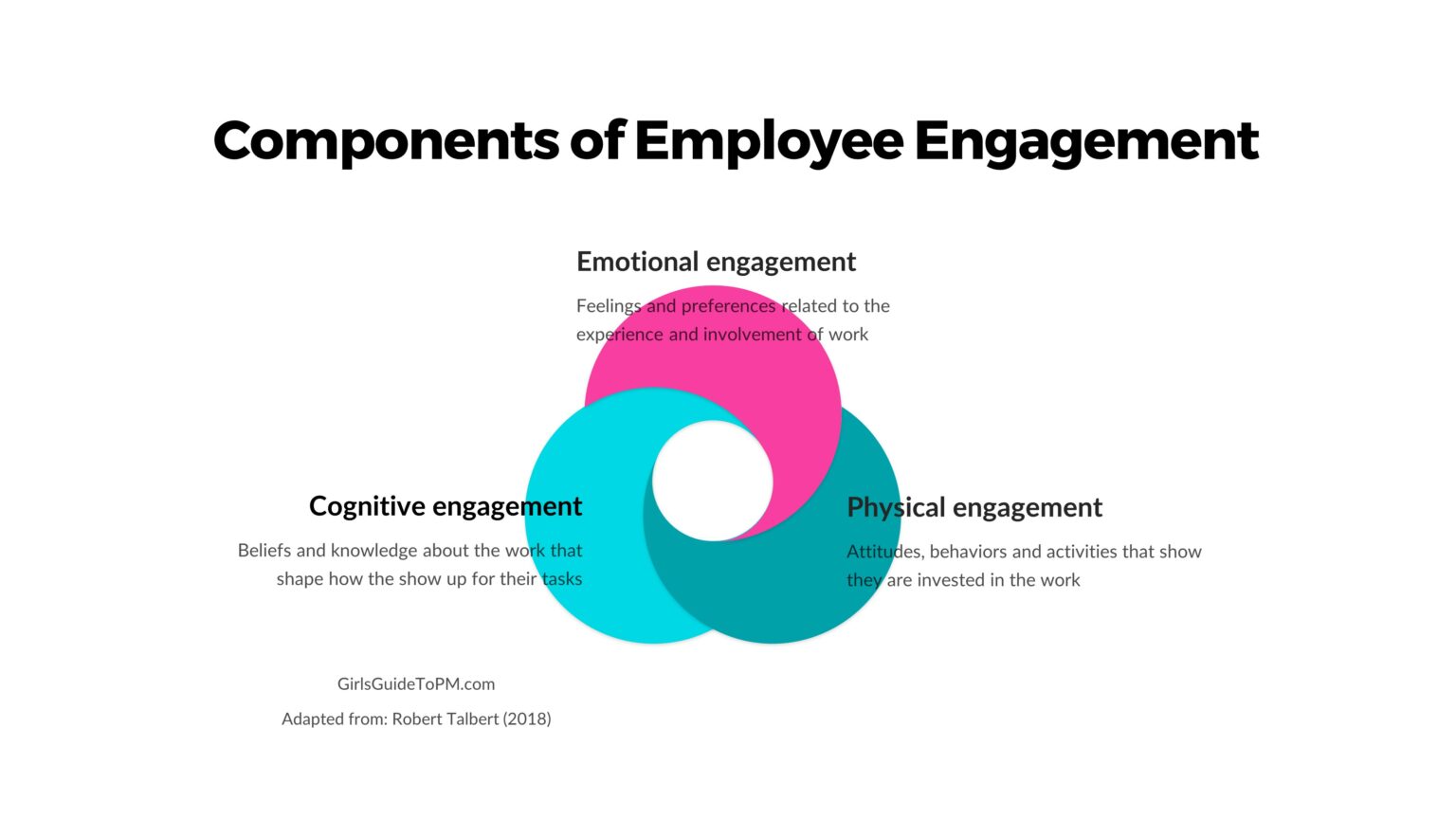
However, the phrase ‘Employee Engagement’ was primarily used by William A. Kahn(1990) in his Management Journal article published at Boston University. Kahn(1990) defined personal engagement as ‘the harnessing of organization members’ selves to their work roles; in engagement, people employ and express themselves physically, cognitively, and emotionally during role performances’.

Image Link: (https://rebelsguidetopm.com/wp-content/uploads/2021/04/Components-of-employee-engagement-1200x675.jpg)
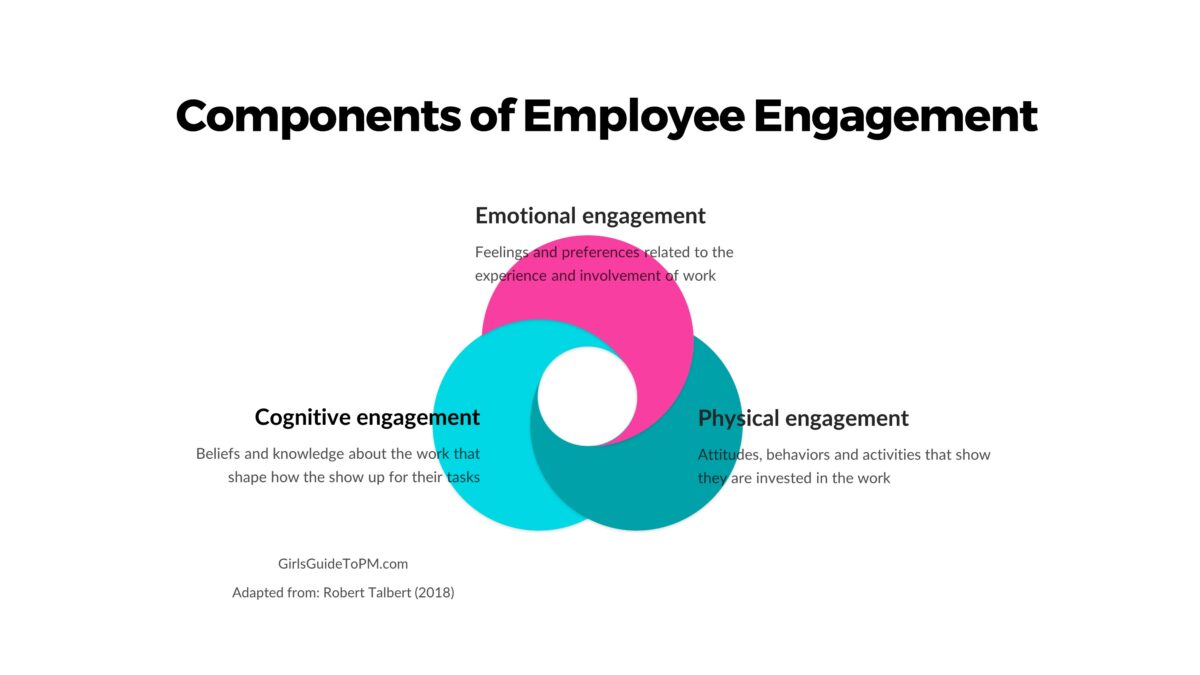
Psychological Conditions Affect
Employee Engagement
Kahn’s work focuses on the conditions that allow employees
to bring “full selves” into the workplace. The researcher identifies three main
factors that affect whether an employee can meaningfully connect with the
organizational mission, company culture, and daily tasks of the role:
meaningfulness, safety, and availability. (Robinson, 2022)
Meaningfulness: Meaningfulness refers to the purpose
behind the work. An employee who understands the ways in which a company’s
product or service benefits society and identifies as an important contributor
towards that goal is likely to make a significant effort. (Robinson, 2022)
Safety: An employee that feels psychologically safe
in the work environment, who does not fear facing judgment or consequences from
teammates or higher management, is more likely to contribute and feel positive
about those contributions. (Robinson, 2022)
Availability: Availability refers to an employee’s
capacity to perform a role both physically and mentally. Every human being has
limits. While challenge is important for growth and satisfaction, a worker
should feel that the demands of the position are reasonable and achievable.
Work life balance is one element that falls under the umbrella of availability.
(Robinson, 2022)


Kahn's(1990) Model of Employee Engagement

Image Link: (https://www.researchgate.net/profile/Simone-Meskelis/publication/326262753/figure/fig2/AS:646260704940032@1531091967412/Kahn-1990-Model-of-Employee-Engagement.png)
Conclusion
Employee
Engagement concept is not alien and widely using in today’s global context.
However, it is important to go back and have a look at these basic principles,
to know the foundation and for smarter application of the same.
References
Hi Thilini, A great article. As per my understanding, employees who feel more engaged have more positive perceptions of their own strengths and weaknesses. That means the more you engage more you identify yourself. That may help to explain employees who feel engaged and more confident in their ability so they can produce better outcomes for the organization. what is your opinion on that?
ReplyDeleteHi Kasun, completely agree with your opinion. Not only that, Employees who are engaged with their job and employer are more productive because they are motivated beyond personal factors. They are more focused and more motivated than their disengaged counterparts. This means they work more efficiently and with the success of the organisation in mind. (Insync, 2023)
DeleteGood article Thilini. As per my readings, Kahn's Theory of Engagement suggests that employees who are engaged in their work experience a sense of psychological presence, physical involvement, and emotional commitment. According to Kahn, engagement is not simply a measure of job satisfaction, but rather a deeper level of involvement in the work itself. Engaged employees are more likely to experience positive emotions, have higher levels of motivation, and are more likely to perform at their best (Kahn, 1990). Furthermore, engaged employees tend to have a stronger connection to their organisation and its mission, leading to increased loyalty and commitment (Shuck & Reio, 2014). As such, organisations should prioritise strategies that promote engagement, such as providing opportunities for growth and development, fostering a positive work environment, and recognising and rewarding employee contributions. By investing in employee engagement, organisations can improve performance, retention, and overall success.
ReplyDeleteHi Lasni, strongly agree with your input. As you correctly said, by investing in employee engagement, organisations can improve performance, retention, and overall success.
DeleteHi Thilini, Great article on Kahn's Theory of Engagement. It highlights the importance of meaningfulness, safety, and availability in fostering employee engagement. Appreciate the fact you have used infographics to add clarity, overall a well written and informative post!
ReplyDeleteThank you Hushmath, I am happy that you found this article well written and informative.
DeleteI completely agree with the article that the concept of employee engagement is crucial for the success of any organization. As discussed by Robinson (2022), the roots of the concept can be traced back to Elton Mayo's early research on team building. However, it was William A. Kahn (1990) who defined personal engagement as the "harnessing of organization members' selves to their work roles."
ReplyDeleteFurthermore, I strongly believe that psychological conditions play a significant role in influencing employee engagement. The three main factors identified by Kahn (1990) - meaningfulness, safety, and availability - are crucial in determining an employee's connection with the organizational mission, company culture, and daily tasks. As highlighted by Robinson (2022), meaningfulness refers to the purpose behind the work, safety refers to the psychological safety of the employee in the work environment, and availability refers to an employee's capacity to perform a role both physically and mentally.
In conclusion, I agree with the author that understanding the basic principles of employee engagement is crucial for the effective application of the concept in the workplace. As pointed out by Dickmann and Baruch (2011), managing global careers requires organizations to ensure that employees are fully engaged and committed to their work roles, which is essential for achieving organizational goals.
Thank you Hassan, strongly agree with your input. Understanding the basic principles of employee engagement is crucial for the effective application of the concept in the workplace.
Delete